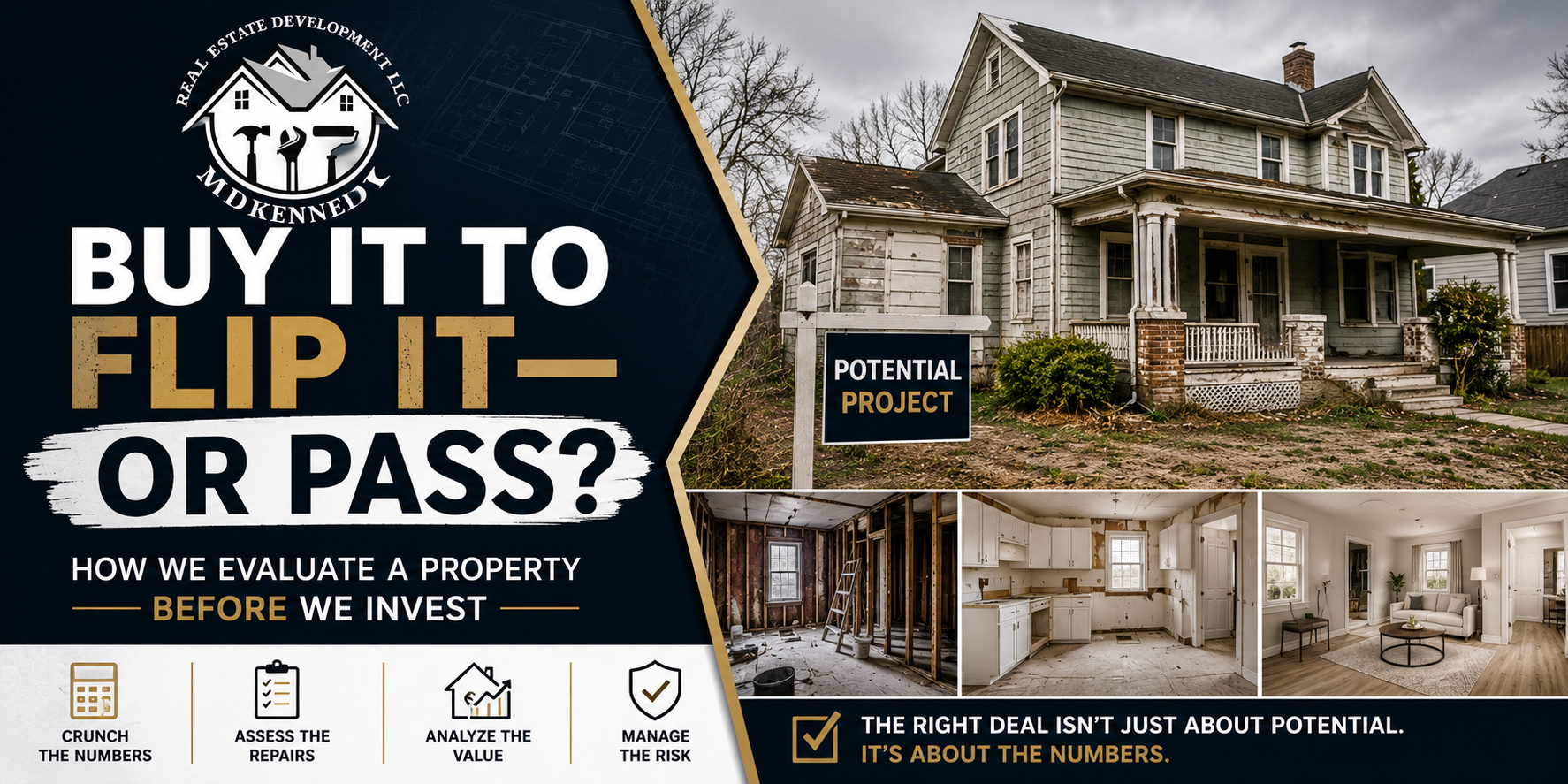
We could see the potential in this property—but after looking at the full scope of work and the numbers, we decided to pass.
Not every house that needs work is a good flip.
In fact, some of the properties that look like the biggest opportunities can become the biggest headaches once you start adding up the repairs, holding costs, financing, and the surprises hidden behind the walls.
At MDKennedy Real Estate Development, one of the most important decisions we make happens before we ever swing a hammer:
Do we buy it to flip it—or pass?
The Purchase Price Is Only the Beginning
A low asking price can get your attention, but it doesn't automatically make a property a good investment. Here is everything that has to be weighed together:
What goes into the math
- Purchase price
- Renovation costs
- Financing and carrying costs
- Taxes and insurance
- Utilities
- Closing and selling expenses
- Expected resale value
- Project timeline
- A cushion for the unexpected
The question isn't simply, "Can we make this house look good?" Most houses can be improved with enough money.
The better question is: "Can we complete the project, sell it at a realistic price, and still have enough margin to justify the risk?"
Start With the Finished Value
Before determining what we're willing to pay, we need a realistic idea of what the property should be worth after the renovation.
That means looking at comparable properties that have actually sold in the area—not simply choosing the highest-priced house currently listed and assuming ours will sell for the same amount.
Location, square footage, bedrooms, bathrooms, lot size, garages, condition, school district, and buyer demand all affect the finished value.
If the numbers only work when everything goes perfectly and the house sells at the very top of the market, the deal probably doesn't work.
Then We Look at What the House Really Needs
Cosmetic projects are relatively easy to estimate. Paint, flooring, cabinets, countertops, fixtures, and landscaping can usually be identified during the initial walkthrough.
The expensive problems are often the less exciting ones:
- Roof
- Foundation
- Structure
- Electrical
- Plumbing
- HVAC
- Windows
- Septic
- Drainage
One major repair may not kill a deal. Several major repairs happening at the same property can.
A house needing a new kitchen isn't necessarily a problem. A house needing a kitchen, roof, windows, foundation repairs, structural work, and major mechanical upgrades is an entirely different calculation.
We Also Look at How Much Work the Property Needs for Its Neighborhood
There's a limit to how much buyers will pay for a house based on the surrounding market.
You can install premium finishes throughout a property, but if comparable homes in the neighborhood sell within a certain range, buyers and appraisers aren't necessarily going to give you dollar-for-dollar credit for those upgrades.
The renovation has to make sense for the property.
The goal isn't to build the most expensive house on the street. It's to create a finished home that buyers want while staying within the value supported by the market.
Time Matters More Than People Think
Every additional month costs money. Taxes continue. Insurance continues. Utilities continue. Interest continues.
And capital tied up in one project can't be used somewhere else.
That's why two properties with the same projected profit aren't necessarily equally attractive. A straightforward renovation that can be completed quickly may be a much better investment than a complicated project that could drag on for months.
The Unknowns Need to Be Priced In
Anyone who has renovated older homes knows that the scope can change quickly once demolition starts.
You might uncover rotted framing. Old wiring. Plumbing that needs replacement. Water damage. Structural problems that weren't visible during the walkthrough.
A flip shouldn't require perfect conditions to make money. There needs to be room in the numbers for something to go wrong—because eventually, something will.
Sometimes the Best Deal Is the One You Don't Buy
Walking away from a property can be difficult, especially after spending time analyzing it and imagining what it could become.
But potential isn't the same thing as profitability.
We've walked through properties where we could clearly see the transformation. We knew how we could improve the layout, update the exterior, replace the kitchen, repair the floors, and completely change how the house looked.
But once the entire scope was added together, the numbers didn't make sense.
That's when the right decision is simple:
Pass.
There will always be another property. Protecting your capital and waiting for the right opportunity is part of successful real estate investing.
Buy It to Flip It—or Pass?
When we evaluate a potential flip, we're balancing three things:
A house can have tremendous potential and still be a bad investment.
The best flips aren't necessarily the houses purchased the cheapest or transformed the most dramatically. They're the properties where the purchase price, renovation budget, timeline, and finished value all work together.
Sometimes we buy it. Sometimes we pass.
Knowing the difference is where the real work begins.
Thinking about a property that needs work?
Have a property that needs work—or one you're considering buying? MDKennedy Real Estate Development brings construction and real estate experience together to evaluate what a property needs and what makes sense.
Talk to MDKennedyBy
Matthew Kennedy
4 min read