
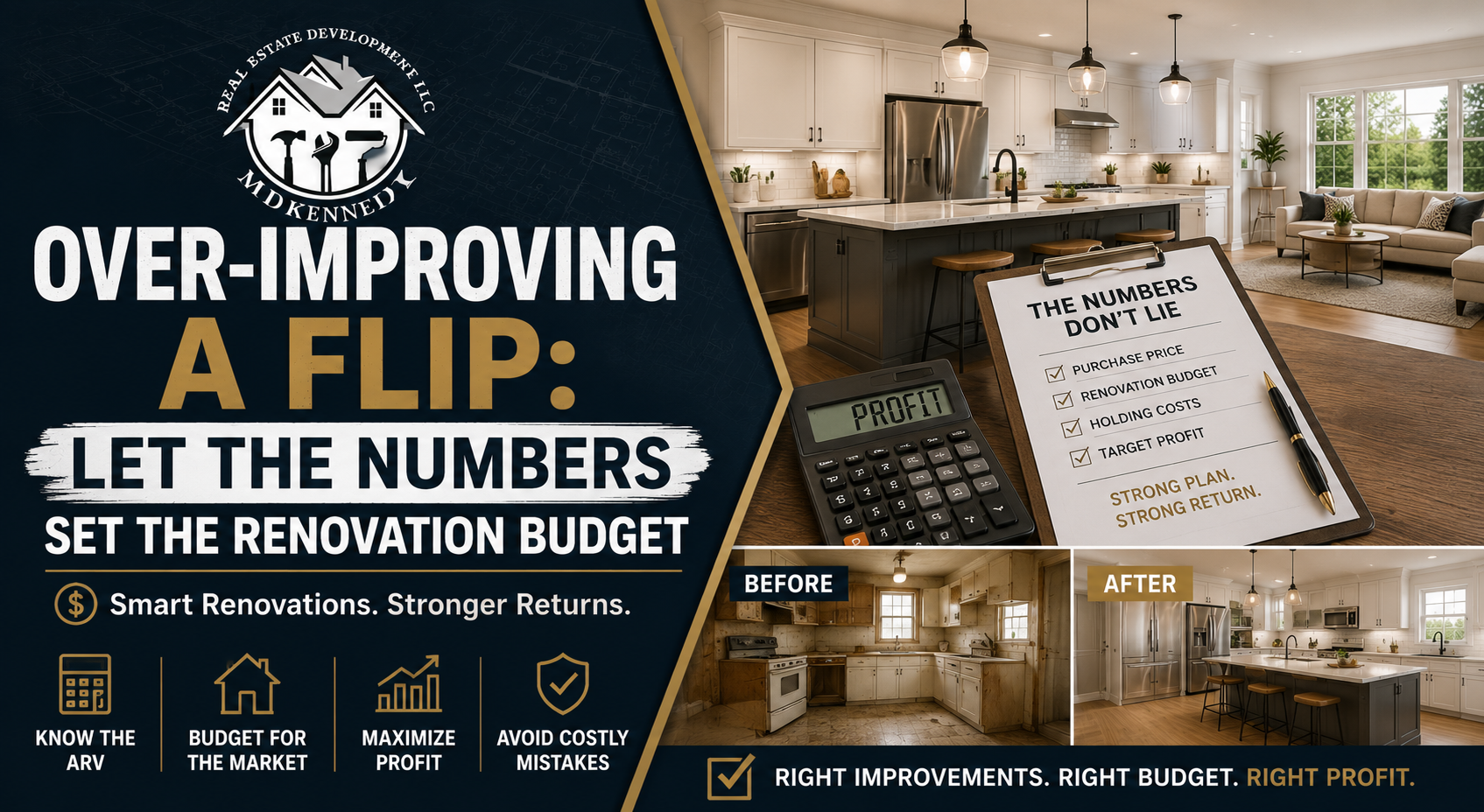
One of the easiest ways to lose money flipping a house is also one of the easiest mistakes to make: you improve the property too much.
When you walk into a dated house, it's easy to immediately start thinking about everything you could do to it. New kitchen. Better cabinets. Tile shower. New flooring. Upgraded lighting. New deck. Maybe open up a wall.
But before deciding what the house needs, a real estate investor should answer a much more important question.
That number should drive almost every decision that follows.
Start With the Finished Value
Before buying a flip, you need a realistic estimate of what the property will be worth after the renovation. Investors commonly refer to this as the After Repair Value, or ARV.
The important word there is realistic. Your ARV should be based on what comparable renovated homes are actually selling for—not what you hope the property will sell for.
Compare against homes in the same market with similar:
- Square footage
- Bedroom and bathroom count
- Lot size
- Garage and outbuildings
- Location
- Condition and level of renovation
If comparable renovated homes are selling around $250,000, installing higher-end finishes doesn't necessarily turn your property into a $300,000 house.
The market still determines the value.
Work Backward From the Sale Price
Once you have a realistic selling price, you can start working backward. Here's a simple example.
That $70,000 is not your renovation budget. It still has to cover financing costs, taxes, insurance, utilities, commissions, closing costs, maintenance, and other carrying or selling expenses. What's left after those is your actual renovation budget.
That number—not your wish list—should determine the scope of the project.
The House Doesn't Care What You Spent
This is where investors can get themselves into trouble.
Suppose your numbers tell you that you can afford to spend $45,000 renovating the property. You could probably find $70,000 worth of improvements to make. That doesn't mean you should.
A $12,000 countertop package might look better than a $5,000 option. A custom tile shower might look better than a standard tub surround. Premium flooring might look better than a good mid-range product. But will buyers pay enough more for those improvements to justify the additional cost?
If spending an extra $20,000 only increases the eventual sale price by $5,000 or $10,000, you didn't improve the investment.
When evaluating a flip, the goal isn't to make every possible improvement. The renovation scope needs to make sense based on the property's anticipated resale value.
Renovate for the Market
The goal of a flip isn't to build the house you would personally want. It's to create a home that buyers in that particular price range and market will want to purchase.
That distinction matters. A $500,000 property may require a completely different level of finishes than a $200,000 property. Buyers have expectations based on price point.
Both directions cost you: under-improving a property can hurt its value and marketability, but over-improving it can be just as damaging to the investment.
You want the finished property to compete with—or ideally be slightly better than—the other homes buyers are considering, without spending money on improvements the market won't reward.
Separate Necessary Work From Optional Upgrades
Before construction begins, divide the project into two categories.
Required to sell
The work needed to make the property safe, functional, financeable, and competitive.
Depending on condition, that might include roofing, electrical repairs, plumbing, HVAC, structural repairs, windows, flooring, paint, kitchens, or bathrooms.
Deserves extra scrutiny
Upgrades that might make the house nicer but aren't required to reach your target selling price.
This is also where structures like an aging detached garage belong—worth evaluating on their own numbers before any money goes in.
Will spending this money increase the sale price or improve the property's marketability enough to justify the expense?
If the answer is no, the money may be better left in the project as profit.
Leave Room for the Unexpected
There's another reason not to spend your entire renovation budget on finishes. Houses surprise you.
Once demolition begins, you may discover damaged framing, outdated wiring, plumbing problems, water damage, or other repairs that weren't obvious during the initial walkthrough.
- Damaged framing
- Outdated wiring
- Plumbing problems
- Water damage
- Hidden structural repairs
Build in a contingency: if every dollar is already committed before construction starts, one unexpected problem can quickly eat into your expected profit.
Every Upgrade Needs a Reason
There's nothing wrong with making a flipped house look great. Presentation matters. Buyers notice good workmanship, thoughtful design, and a house that feels finished.
But every improvement should serve the investment.
Those are two very different questions.
Buy Based on the Numbers, Then Renovate Based on the Numbers
A successful flip starts before anyone swings a hammer. It's the same discipline we apply when we decide whether a property is worth buying at all.
- Start with the anticipated resale value.
- Subtract the purchase price.
- Determine the profit you need to make.
- Account for your acquisition, financing, carrying, and selling costs.
- Then determine what remains for construction.
Anticipated Sale Price – Purchase Price – Target Profit – Other Project Costs = Renovation Budget
Once you know that number, build a renovation plan that fits inside it. Because in real estate investing, spending more doesn't automatically mean making more.
Thinking About Buying a Property to Renovate?
Before you buy, understanding the potential resale value and renovation scope can make the difference between a profitable project and an expensive mistake. MDKennedy Real Estate Development has firsthand experience buying, renovating, and evaluating properties throughout Western New York.
Discuss Your Next ProjectBy
Matthew Kennedy
5 min read

.png)